


Almach
العناقthe caracal
Reader
Reads every recorded instrument, field by field: the parties, the dates, book and page, the legal description. Each field keeps its confidence and the place on the page it came from.
Property Intelligence
Rectangular AI searches the county's records, reads every instrument and builds the chain of title, then carries one file from the Abstract of title to the commitment, the closing and the policies. Every finding links to the page it came from. Your examiners make the call.
How it works
Nine steps, from the first search to the policies. Each one hands its work to the next, and each one leaves evidence you can open.
Locate
Rectangular AI finds the parcel on the county's tax roll and parcel map. If an owner holds several parcels, it stops and asks which one.
Search
By lot, by section, and by every way the owner's name is written: both orders, nicknames and organizations. The state's tax lien registry too, where it keeps one.
Retrieve
Deeds, mortgages, releases, plats and judgments. A document downloaded twice is kept once.
Read
Parties, dates, book and page, and the legal description. Each field keeps its confidence and the region of the page it came from.
Reconcile
A date later than the filing, a deed recorded twice or a placeholder date is caught. Anything doubtful goes to review.
Connect
A lender can never bridge two unrelated owners. Foreclosures, trustee’s sales and tax sales are followed, so the chain does not stop at a sale.
Clear
What remains open is listed, with judgment and lien registry results. A search that fails is marked incomplete, never clear.
Examine
Doubtful items become questions, each with its evidence open beside it. Decisions are kept through every re-run, and each rule decides, suggests or asks, as your organization sets it.
Commit and close
Schedule A, B-I and B-II are drafted from the record, your codebook and your underwriter’s manual, and an AI reviewer checks the draft. A reviewer approves an exact revision. After the closing, the file watches the recording and drafts the policies.
Andromeda
A county's records are a cloud of thousands of points. Seven constellation agents make sense of them, and each orchestrates its own team of specialist agents and tools: 71 in all. Every one shows its work, and none of them signs off. Your examiner decides.
Search and data intelligence run on one graph of the record: owners linked by the recorded instruments between them. An ontology feeds it, telling a deed from a mortgage from a release, and a person from a company from a lender. A search walks the graph back, owner to owner, and a deed read for one file is ready for every file that cites it.
Drag to rotate in 3D.Swipe sideways to rotate in 3D.
the caracal
Reader
Reads every recorded instrument, field by field: the parties, the dates, book and page, the legal description. Each field keeps its confidence and the place on the page it came from.
the string of pearls
Chain builder
Reasons from owner to owner, back through every conveyance, as far as the search requires. Each link is tied to the deed that makes it.
the shepherd
Compliance
Makes sure nothing that must be checked is missed: tax standing, judgments, the sanctions lists, bankruptcy where enabled, the lien registry, and every search the checklist requires.
the weight
Title reasoning
Weighs the chain, the liens, the judgments and the rules, then proposes the title’s conclusion: who holds title, the requirements and the exceptions, each with its reason.
the ship
Compiler
Assembles the report and the exports (the commitment as PDF, Word or JSON, an attorney’s opinion, a search audit) and delivers them by signed webhook.
the trotting camel
Assistant
Works beside your examiner. Ask it about the file, and it answers with citations to the instruments behind the answer. It reads the order into Schedule A, and proposes changes your examiner accepts or not.
the glance
Datedown
Brings the file forward from its effective date: reads only what is new, asks the judgment, sanctions and bankruptcy sources again, and keeps every decision already made.
Beneath the seven
71
specialist agents and tools, each built for one job.
The title file
Five stages, one title file: the Abstract of title, the examination, the commitment, the closing and the policies. Screens from the app, on a sample file with invented owners.
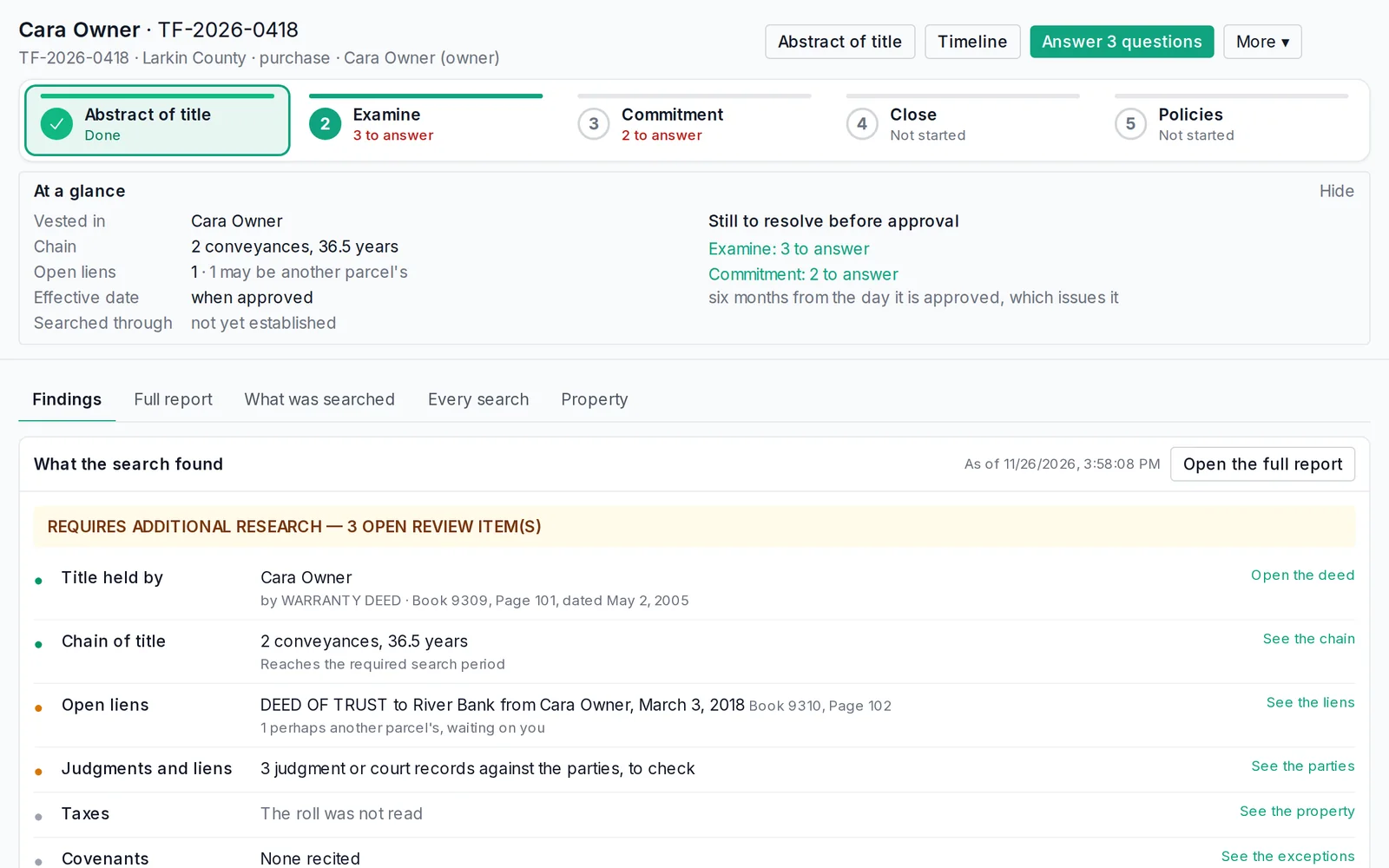
01 · Abstract of title
Who holds title and by which deed, the chain and how far back it reaches, the open liens, judgments, taxes and covenants, and how far the county’s index has been searched.
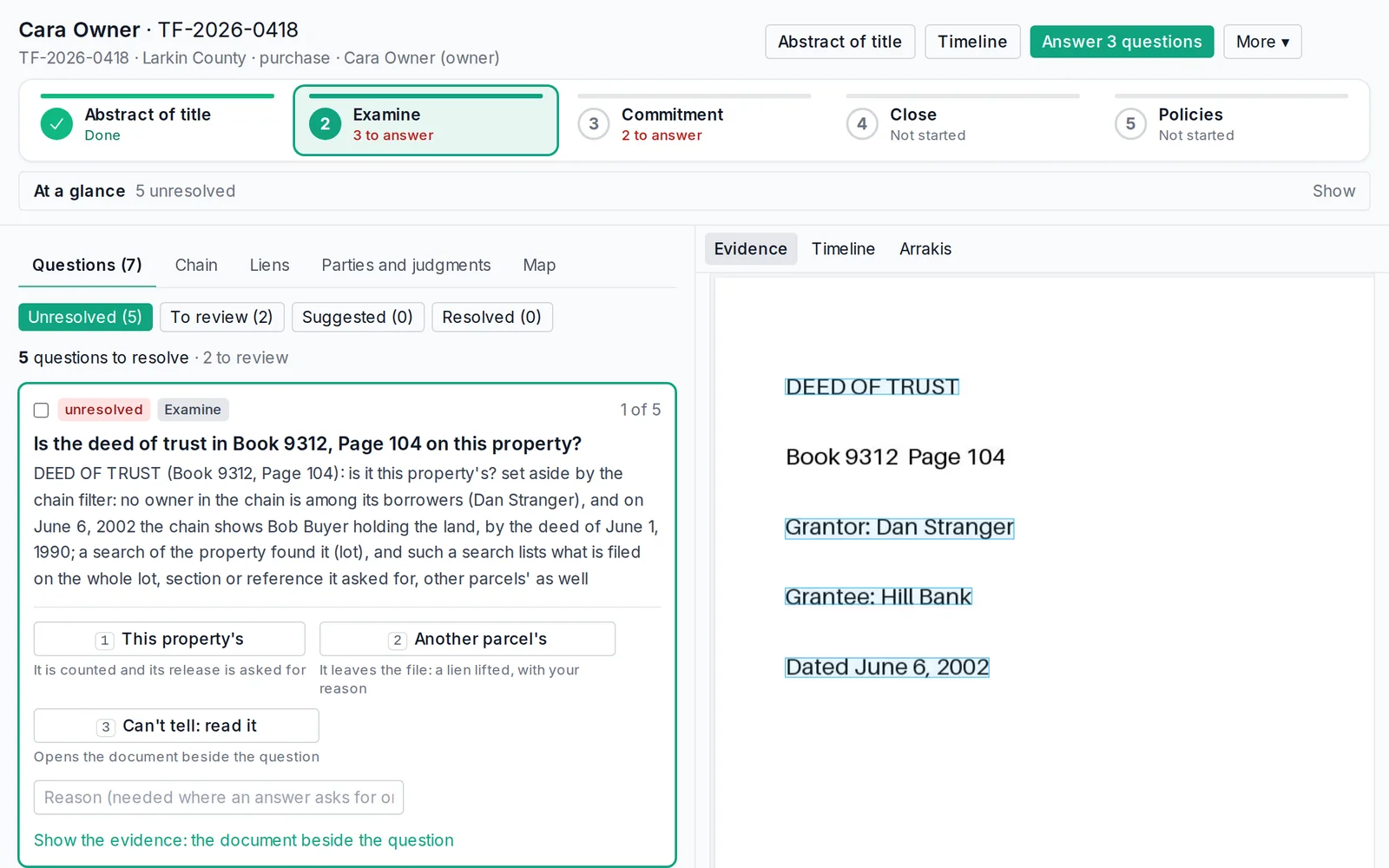
02 · Examine
Doubtful items become questions, each with its evidence open beside it: the recorded page, every field it read outlined where it was read. Answer several of one kind at once, and undo any answer.
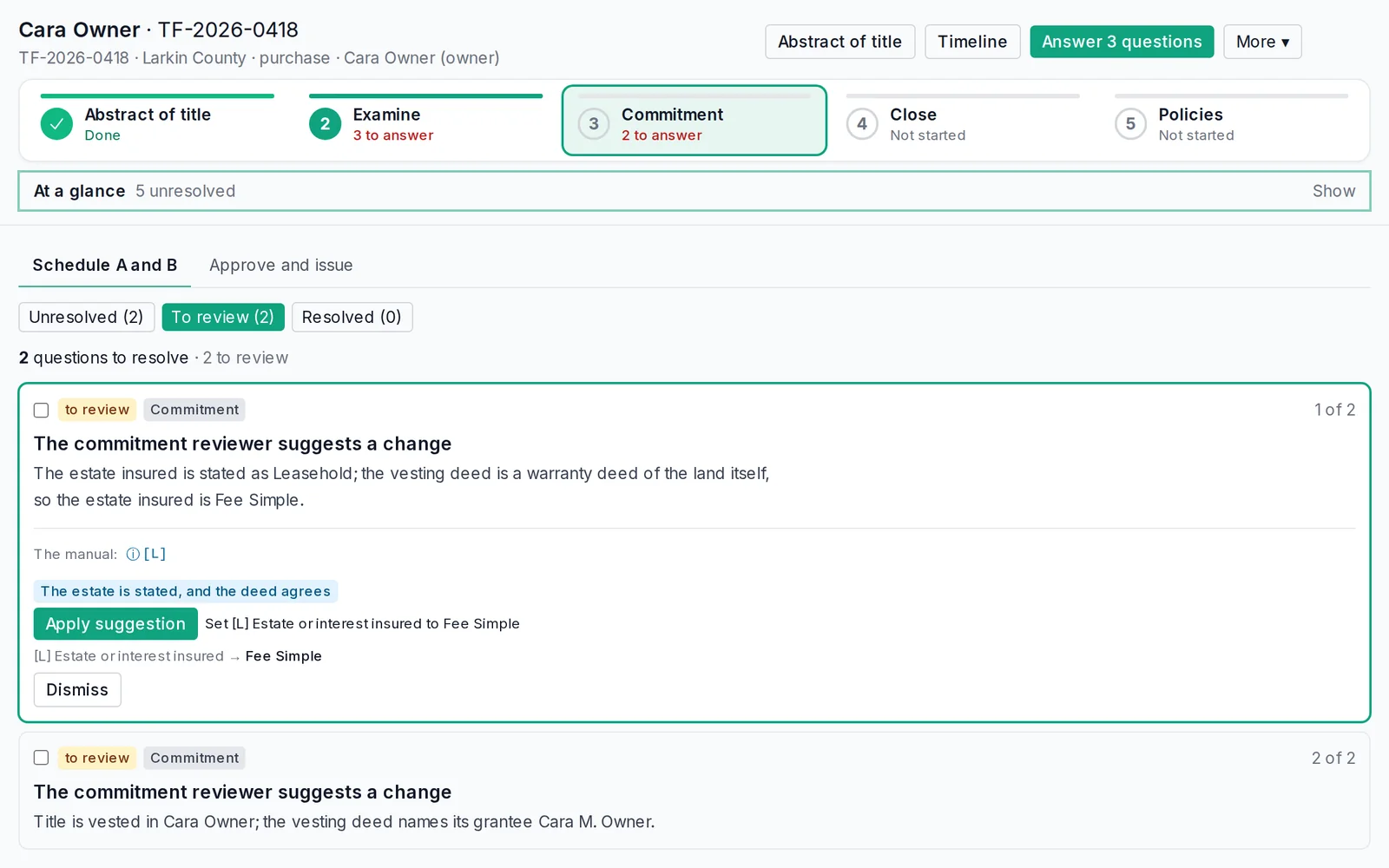
03 · Commitment
The order fills Schedule A, and Arrakis can read it from the order’s PDF. Requirements and exceptions come from the record, your clause codebook and your underwriter’s manual, and an AI reviewer checks the draft. Nothing is saved until your examiner saves it.
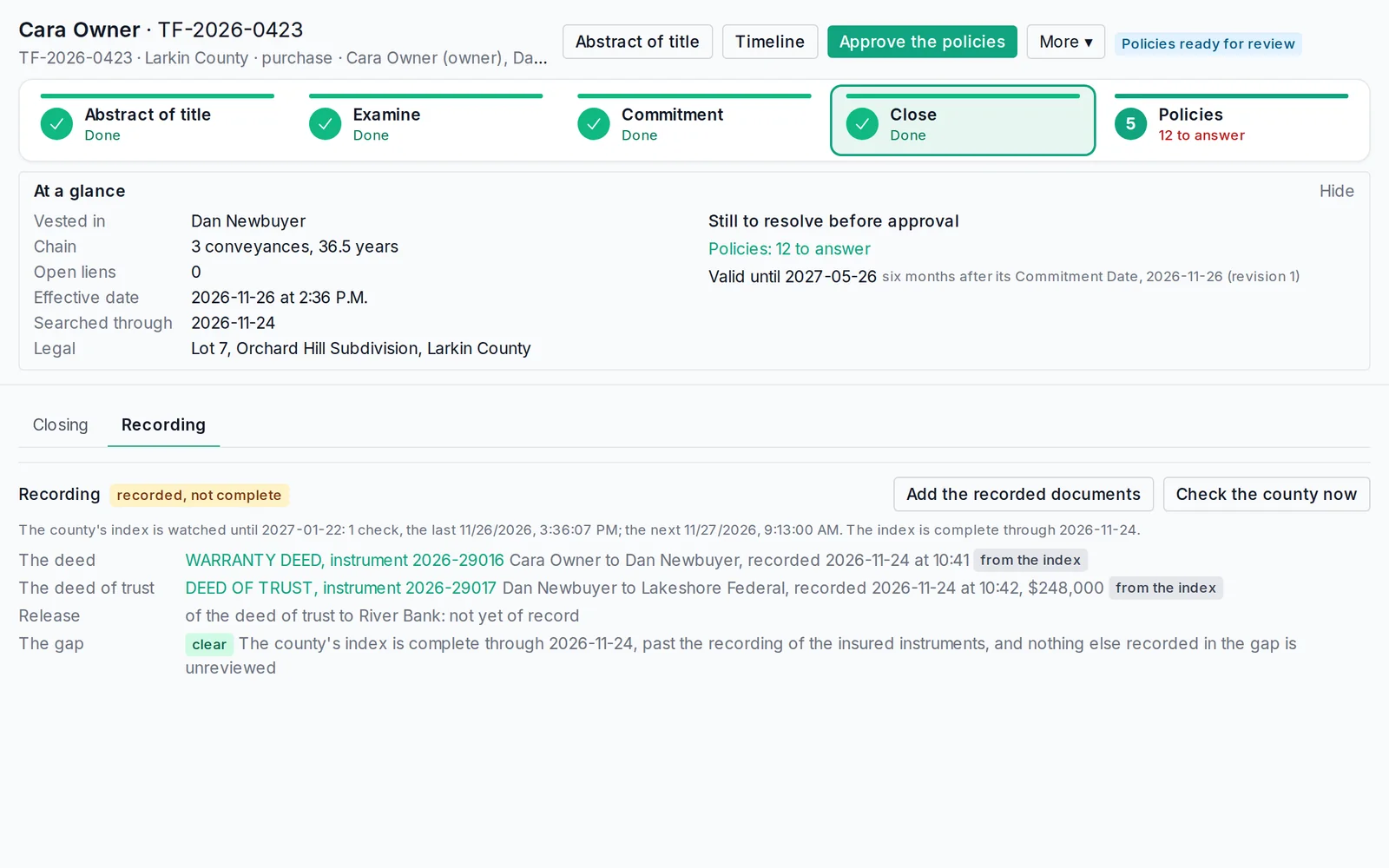
04 · Close
Record the closing, and the file checks the county’s index for the new deed, the new deed of trust and the releases Schedule B‑I requires, and lists anything else recorded in the gap.
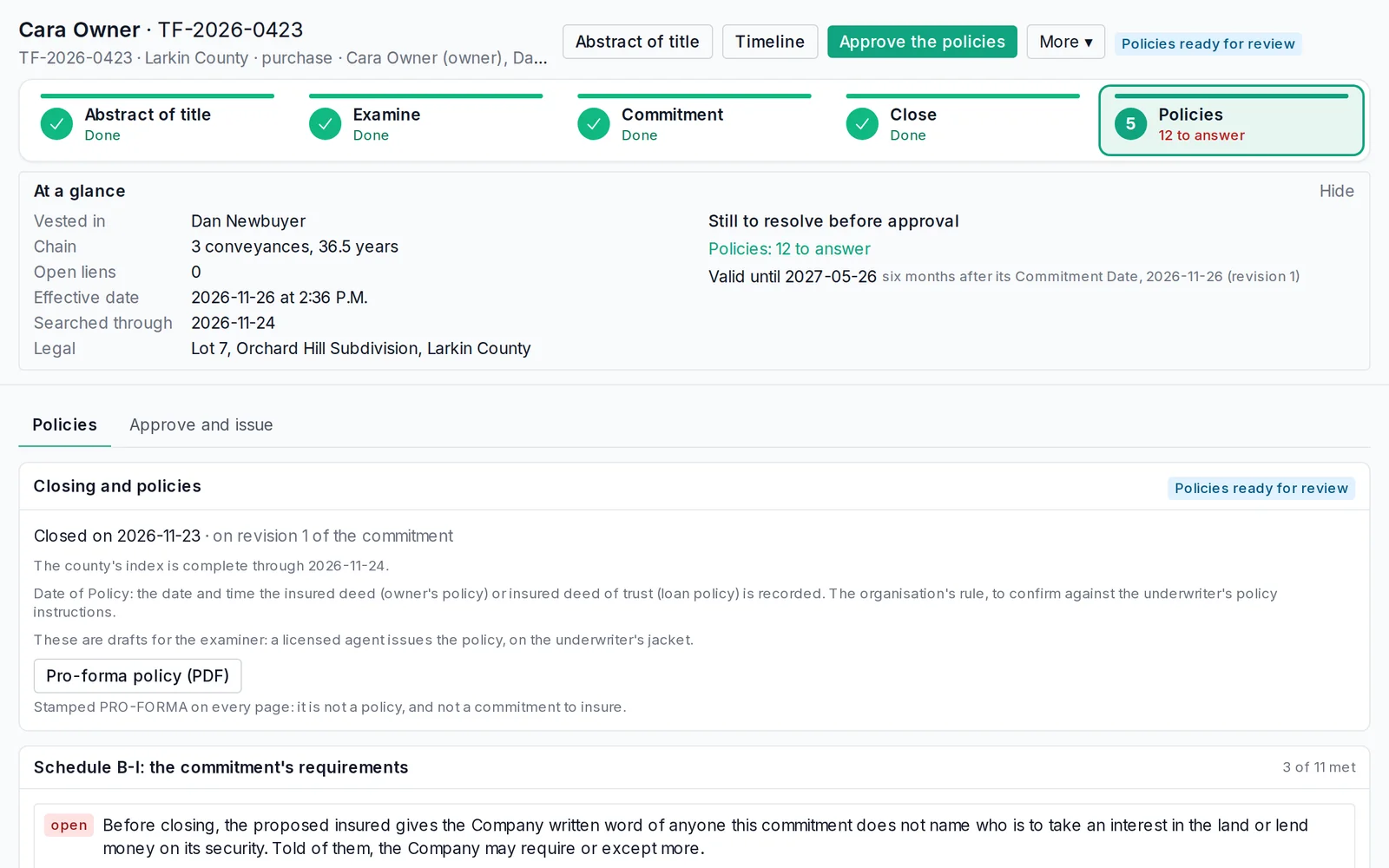
05 · Policies
Each policy is drafted from the approved commitment on the ALTA forms, with what has been recorded since. Every Schedule B‑I requirement shows as met, by an instrument or your examiner’s decision, or still open.
The workbench
Every stage proposes and your examiners decide. Approval needs a reviewer with a licence or bar number on file, and binds an exact revision that is never edited afterward.
The approved commitment as PDF, Word or JSON, an attorney’s opinion, a search audit report, and a package with stamped copies. Delivered to your production system by signed webhook.
The file is brought forward from the date its searches reached, reading only what is new, and every decision your examiners made is kept.
Ask about the file: the liens and their releases, the chain, the taxes. It answers with citations, can queue a search or propose a change, and can never approve, reopen, export or delete.
Your clause codebook and each underwriter’s manual, versioned in Settings. Comments, internal notes and @mentions on the file, and an activity log of every change.
We show our work
The file records each search and every row it returned: under which names, how far back, and what only the courthouse holds. So an examiner can see the edges of the search, not just its findings.
If a search fails, the file says incomplete. Never clear.
Scope of search
CompleteThe hard cases
County records were never meant to be read by software. These are a few of the ways they go wrong, and what Rectangular AI does about each.
SMITH JOHN ⇄ JOHN SMITH
Both orders, nicknames and organizations are searched, so a reversed name is not a missed record.
Book 1640 · Page 88 = Book 1647 · Page 301
A re-recorded deed is recognized as the same conveyance, not a new link in the chain.
…, INC. AND MERS → INC MERS
A lender whose name is split across an index row is still a lender, so it cannot join two families’ chains.
Trustee's deed · 2011
Foreclosures, trustee’s sales and tax sales are followed, so the chain does not end at the sale.
Signed 2019-08-14 · Filed 2018-08-14
A deed cannot be signed after it was filed. Impossible and placeholder dates are caught and checked against the index.
[ IMAGE UNAVAILABLE ]
A placeholder served in place of a scan is recognized for what it is, and never read as a deed.
Coverage
We add counties one at a time: each one once we can search its records properly and its terms allow it. Tell us where you work, and we'll let you know when your county is ready.
Security
Rectangular AI runs on Microsoft Azure. These are the controls in place today.
Services sign in with managed identities through Microsoft Entra ID. The running system holds no API keys or connection strings, and the AI services refuse keys altogether.
Recorded documents are kept in storage that is closed to the public internet and reached only over a private endpoint.
A file is reached only through a membership of its organization. To anyone else, it does not exist.
Only an admin or a reviewer can approve, with a license or bar number on file, and the approval records it.
Decisions are append-only, and approval binds an exact revision of the file.
The assistant cites the instruments it relies on. It can never approve, reopen, export or delete, and every call it makes is logged.

About
Across most of the country, land is measured on a grid. The rectangular survey, begun in 1785, laid thirty states out in townships six miles square, each of thirty-six sections, each section split into quarters. A deed can name a parcel by its place on that grid.
In other states, deeds walk the boundary by metes and bounds, and in towns everywhere they name a lot and block on a recorded plat. Rectangular AI reads all three: the legal description is one of the fields it reads in every instrument it retrieves.
The name holds a second rectangle: the box drawn around every field it reads, on the page it came from, so you can check each finding at its source.
The founders
Rectangular AI brings together more than twenty-five years of law practice and more than a decade of building AI.
Attorney at law
Kirk has practiced law since 1999. After eighteen years at Hickman, Goza & Spragins, he opened his own firm in Oxford, Mississippi, in 2017, and in 2025 became a partner at Hyneman & Milam. He is a graduate of the University of Mississippi School of Law and is AV Rated by Martindale-Hubbell.
Kirk Milam on LinkedInAI and data scientist
As a senior data scientist at Microsoft, Ali designed and built AI software for Fortune 100 companies and financial institutions. Before that he spent nearly eight years building AI at Athenium. He holds a Ph.D. in computer engineering from the University of Alabama at Birmingham. His research has been published by IEEE and ACM and at a NeurIPS 2026 workshop, and he is a named inventor on US patents, including one for an AI system that assesses properties from aerial imagery.
Ali Darwish on LinkedInFAQ
No. Rectangular AI searches the record, reads it and builds the title file. It does not issue policies or give legal advice: your examiners, attorneys and underwriter make every decision.
Your examiners. A run proposes findings, and an examiner decides on each one. Those decisions are kept through every re-run. Only an admin or a reviewer can approve the file, and approval binds an exact revision.
Yes, for your examiner to finish. The order fills Schedule A, requirements and exceptions come from the record, your clause codebook and your underwriter’s manual, and an AI reviewer checks the draft and proposes changes. Nothing is saved until your examiner saves it, and a reviewer approves the exact revision that is issued.
Yes. A new organization gets three reports free, to try the workbench on your own files. After that, each report is charged when it is delivered, and a search that fails costs nothing.
See pricingWe add counties one at a time, each once we can search its records properly and its terms allow it. Tell us where you work, and we'll let you know when your county is ready.
Request your countySome records never made it online: older books, will books, some court records. The file lists them as courthouse only, never as missing, so nothing is taken as clear that wasn't searched.
We will publish accuracy figures once they are measured on real files, and not before. Until then, here is how it guards against error: every field links to the region of the page it was read from, anything doubtful goes to review, and a search that fails is reported as incomplete, never as clear.
On Microsoft Azure. Recorded documents sit in storage closed to the public internet, services sign in without keys, and an organization's files are visible only to its members.
A short walkthrough of a title file, with your examiners in the room.